One Table, Many Hands: How Japanese Communal Dining Can Transform the American Dinner Experience
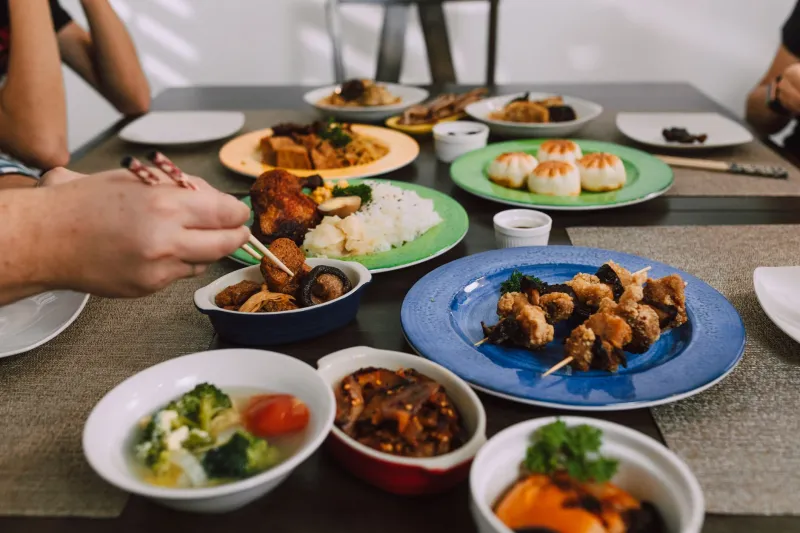
There is a moment, familiar to anyone who has dined at a traditional Japanese table, when the food arrives not in front of you but between you. Dishes settle at the center — a small plate of grilled fish, a bowl of braised root vegetables, a tangle of pickled greens — and the meal begins not with the solitary act of picking up a fork, but with the shared gesture of reaching, offering, and receiving. It is a subtle shift, yet its effect on the atmosphere of a meal is anything but subtle.
In the United States, the prevailing model of dining places a complete, individually portioned plate before each guest. The logic is one of clarity and convenience: you ordered it, it belongs to you, and the transaction is essentially complete the moment the server sets it down. This approach is efficient, and in many contexts it is perfectly appropriate. But it quietly closes off something that the Japanese communal table keeps deliberately, intentionally open.
The Philosophy Behind the Shared Center
Japanese dining culture has long organized meals around the concept of okazu — a collection of side dishes served alongside rice and soup that are meant to be enjoyed together, drawn from as the meal progresses. Rather than a single composed plate, the table becomes a landscape of flavors and textures that diners navigate together. No single dish belongs to any one person. Every hand that reaches toward the center is, in a small but meaningful way, an act of participation in a collective experience.
This arrangement reflects a broader cultural value that Japanese society has cultivated for centuries: the understanding that a meal is not merely sustenance, but a form of sustained human contact. When food is shared from common dishes, the pace of eating naturally synchronizes. Diners pause to observe what others are selecting, to recommend a particular combination, to notice when a favorite dish is running low and to offer the last portion to someone else before taking it themselves. These micro-moments of consideration accumulate into something larger — an evening in which people are genuinely present with one another.
What Individual Plating Quietly Takes Away
Consider the typical American dinner party or family meal. Each person receives their plate, and while conversation certainly flows, the food itself rarely functions as a vehicle for interaction. There is little reason to ask, have you tried this yet? or let me pass that to you first. The meal is already distributed. The negotiation — small, warm, and fundamentally human — never occurs.
Research in social psychology has consistently found that shared eating experiences increase trust and cooperation between people. A 2017 study published in Psychological Science found that individuals who ate similar foods during a negotiation reached agreements more quickly and with greater satisfaction than those who did not share food. While the study did not focus specifically on Japanese dining customs, its findings align closely with what the communal table has quietly understood for generations: that sharing food is a form of alignment, a way of saying we are in this together.
The individual plate, for all its practicality, can inadvertently signal the opposite — that each person's experience at the table is ultimately their own, separate and self-contained.
Bringing the Communal Table Home
Adopting elements of Japanese communal dining does not require a complete overhaul of how you cook or entertain. It begins with a change in intention — a decision to place the meal at the center of the table rather than in front of each individual.
Start with three or four small dishes rather than one large entrée per person. Think in terms of contrast: something warm alongside something cool, something rich alongside something bright and acidic. A simple miso-glazed eggplant, a plate of sliced cucumber dressed with rice vinegar and sesame, a bowl of slow-simmered chicken with ginger — served together at the center of the table, these become an invitation rather than an assignment.
Resist the urge to pre-portion everything. Allow the dishes to remain whole and accessible throughout the meal. Provide serving utensils, and if you are hosting guests unfamiliar with the format, offer a brief, warm explanation: tonight we're sharing everything, so please help yourself to whatever looks good to you. That single sentence changes the social contract of the table entirely.
The Conversation That Food Can Start
One of the less obvious gifts of the communal table is that it generates conversation naturally, without effort or engineering. When a dish sits at the center, it becomes a point of common reference. What is that seasoning? I've never had this vegetable prepared this way before. Try it with the rice — it's completely different. Food, when shared, becomes a subject rather than just a backdrop.
Families with young children often find that communal dining shifts the dynamics of the meal in ways that individual plating does not. Children who might resist a new ingredient on their own plate are frequently more willing to try something they see others reaching for enthusiastically. The shared center removes the pressure of this is yours and you must eat it and replaces it with the more permissive atmosphere of this is ours, and you are welcome to explore it. The distinction matters more than it might initially appear.
An Invitation Worth Accepting
At Tamaniwa Ebisu, the communal spirit of the Japanese table is something we hold central to every meal we serve. The act of placing dishes at the heart of the table — rather than delivering each guest a sealed, individual experience — is not incidental to Japanese dining culture. It is foundational to it.
The American table, warm and generous as it already is, has much to gain from this orientation. Not because individual plating is wrong, but because the communal model offers something different and increasingly rare: a meal that asks its participants to remain in conversation not just with words, but with every reach, every offer, every quiet moment of noticing what someone else might enjoy.
The next time you set the table, consider moving the food to the center and watching what happens to the people around it. You may find that the dinner you were hosting becomes something closer to a gathering — and that the difference between the two is more significant than you expected.