The Quiet Plate: Mastering the Japanese Principle of Empty Space in Your Own Kitchen
When Nothing Becomes Something
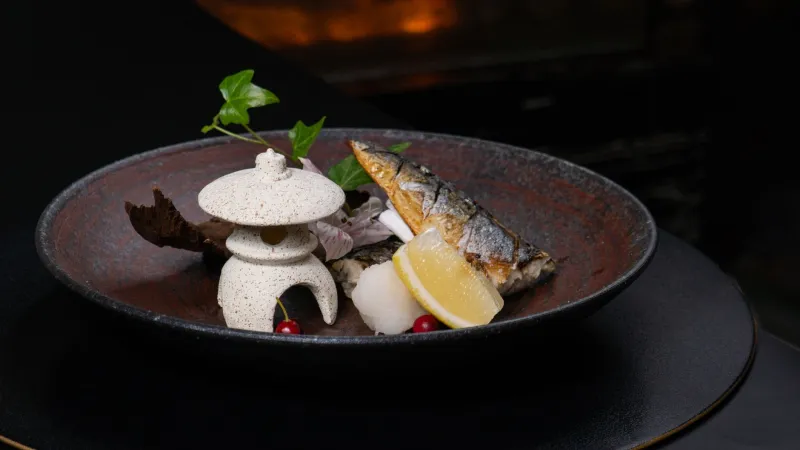
There is a moment, just before a dish is set before you at a traditional Japanese restaurant, when the server pauses. The ceramic bowl arrives slowly, placed with deliberate care. And then you notice it: the food occupies perhaps a third of the surface. The rest is bare, glazed, silent.
For many American diners, that emptiness registers as scarcity. But within the Japanese aesthetic tradition, it is abundance of a different kind.
The concept at work is ma (間)—a term that translates loosely as negative space, pause, or interval. While ma appears across Japanese art, architecture, and music, its presence at the dining table is particularly profound. It is the deliberate act of restraint, the belief that what surrounds an object gives that object meaning. A single slice of sashimi resting near the edge of a wide, matte-black plate is not sparse. It is composed.
At Tamaniwa Ebisu, this principle is woven into every dish we present. And it is something any home cook in America can begin to practice tonight.
The Philosophy Behind the Presentation
Japanese plating aesthetics draw from several overlapping traditions. Zen Buddhism introduced the idea that simplicity is not the absence of thought but the result of it. The tea ceremony formalized this into a precise visual language: one scroll, one flower, one bowl. Nothing competed. Everything resonated.
In food presentation, this translated into a set of guiding sensibilities rather than rigid rules. The goal is not minimalism for its own sake but intention—every element on the plate should earn its place, and the empty areas should feel chosen, not forgotten.
This stands in notable contrast to the abundance-forward plating common in American dining culture, where a generous portion signals hospitality and value. Neither approach is wrong. But the Japanese method invites the diner into a different kind of relationship with their food: slower, more observant, more attuned to detail.
Choosing the Right Vessel
Before a single ingredient is placed, the vessel itself communicates. Japanese tableware—utsuwa—is selected with the same care as the food it holds. A rough-textured, earthy ceramic bowl suggests warmth and rusticity. A smooth, pale porcelain plate evokes delicacy and refinement. The dish is not neutral background; it is part of the composition.
For American home cooks looking to apply these principles, a few practical guidelines help:
- Select dishes larger than you think you need. If you are plating a portion of roasted salmon, reach for a plate that feels almost too generous. The food should occupy no more than half to two-thirds of the surface.
- Embrace asymmetry. Round plates pair well with off-center placement. Rectangular or irregular dishes allow for dynamic diagonal arrangements.
- Vary textures and tones across your tableware collection. A matte-glazed bowl beside a smooth lacquer cup creates visual interest before the meal even begins.
You do not need to invest in an entirely new set of dishes. Even a simple white dinner plate, used with restraint, can approximate this aesthetic beautifully.
The Rules of Placement and Color
Once the vessel is chosen, placement becomes the primary act of composition. Japanese plating typically avoids centering food directly in the middle of a plate—that symmetry reads as static. Instead, ingredients are positioned toward one side or corner, allowing the eye to travel across the open space and settle on the food with greater appreciation.
Color contrast is equally deliberate. A pale, cream-colored tofu placed against a dark slate plate creates immediate visual tension that draws the eye. A vivid garnish—a single shiso leaf, a curl of yuzu zest, three sesame seeds—provides a focal point without overwhelming the composition. The rule of thumb: introduce no more than three distinct colors per plate, and let one dominate.
Portions, too, are considered with care. Japanese cuisine rarely heaps. A thoughtful arrangement of five or seven pieces (odd numbers are considered more dynamic than even in Japanese aesthetics) of a single ingredient communicates more elegance than a generous pile of twelve. This is not about reducing what you eat—it is about how that food is arranged and perceived.
Bringing This Practice to Your Table
Transitioning toward this style of presentation at home does not require culinary school training. It requires slowing down and approaching the plate as a canvas.
Begin with a single meal this week. Choose one dish—perhaps a simple grain bowl, a piece of grilled chicken, or even a weekend breakfast of eggs and toast—and commit to plating it with intention. Ask yourself: Where is the focal point? What is the dominant color, and what provides contrast? Is there enough open space for the eye to rest?
A few additional practices worth adopting:
- Wipe the rim of the plate before serving. This small act, standard in Japanese kitchen discipline, immediately elevates presentation.
- Use odd numbers when arranging small elements such as cherry tomatoes, dumplings, or garnish leaves.
- Resist the urge to fill. If the plate looks too empty to you, it may be exactly right.
- Consider height. Even a modest stack or gentle lean of ingredients introduces dimension without clutter.
The Meditative Dimension
There is something that happens when you begin plating this way regularly. The act of cooking changes. The kitchen becomes quieter, not because it is silent, but because your attention narrows. You are no longer rushing to fill a bowl. You are making decisions, however small, about beauty and balance.
This is, in a meaningful sense, what Japanese dining culture has always understood: the meal begins before the first bite. It begins in the way the food is grown, prepared, and finally placed before the person who will receive it. That placement is a form of communication. It says: this was made with care, and you are worth that care.
In a culture that frequently eats in front of screens, in cars, or standing over a kitchen counter, there is something quietly radical about setting a plate down with intention and sitting with it.
The empty space on the dish is not what is missing. It is what makes room for you.