The Conversation Without Words: Intimacy and Connection at the Sushi Counter
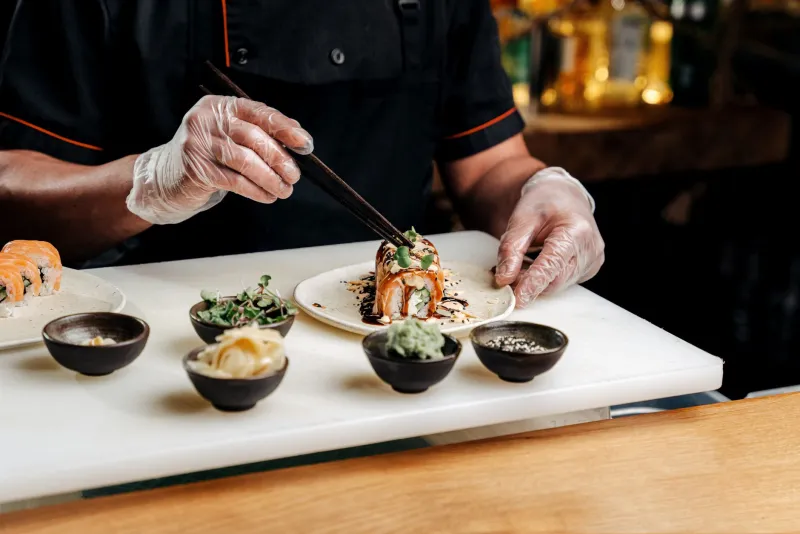
There are very few dining experiences in the world that place a guest in such direct, sustained, and deliberate proximity to the person preparing their food. The sushi counter — that narrow expanse of pale hinoki wood, typically no wider than a forearm's length, separating the chef from the seated diner — is one of them. In Japan, this format has been refined over nearly two centuries. In America, it is increasingly recognized not just as a theatrical arrangement but as a fundamentally different kind of dining relationship.
What happens across that counter is not simply the transfer of food. It is a conversation — one that unfolds largely without words.
Why the Counter Exists: A Brief History
The Edomae sushi tradition that gave rise to the counter format emerged in early nineteenth-century Tokyo, then known as Edo. Street vendors would prepare vinegared rice topped with local fish from Tokyo Bay and hand it directly to customers. As the tradition moved indoors and became more refined, the counter preserved the directness of that original exchange. The chef remained visible, working in real time, and the diner remained close enough to observe every movement.
This arrangement was never purely logistical. It encoded a particular philosophy: that the relationship between the person who prepares food and the person who receives it matters, and that proximity is one way of honoring it. In Japan's most respected sushi establishments, the counter is not a design feature. It is the entire premise.
Reading the Chef: The Diner's Part of the Exchange
For first-time counter diners, the experience can feel slightly bewildering. There is no menu to hide behind, no server to mediate requests, no comfortable distance between yourself and the person responsible for your meal. You are simply — there. Watching. Being watched.
This can be uncomfortable for American diners accustomed to a more transactional dining model. But the discomfort, when it comes, is worth leaning into rather than away from. Because what the counter offers, once you settle into it, is something genuinely rare: the opportunity to witness mastery at close range.
A skilled sushi chef at the counter is a study in economy and precision. Watch how the rice is shaped — the pressure of the fingers, the speed of the motion, the way the nigiri is turned and presented. Watch how the fish is sliced, how the knife enters the flesh and exits cleanly. These are movements practiced thousands of times, refined over years, and they are happening twelve inches from your face. You do not need to understand the technique to feel its quality. The attention required to produce it is palpable.
What the Chef Is Reading in You
The exchange, of course, moves in both directions. An experienced sushi chef at the counter is constantly observing the diner — not intrusively, but attentively. The pace at which you eat, whether you linger over a piece or consume it quickly, the expression that crosses your face after a particular preparation: all of this informs how the chef proceeds.
In the omakase format, where the chef selects every course, this observation becomes the mechanism by which the meal is personalized. A chef who notices that a diner has paused thoughtfully over a piece of aged fish may introduce another aged preparation later. One who sees a guest hesitate over something rich may adjust the balance of the remaining courses toward something cleaner and more austere. The meal responds to you in real time. This is only possible because of the counter's intimacy.
Even in non-omakase counter dining, the proximity creates space for a kind of calibration that simply does not exist when a server takes your order from across the room and relays it to a kitchen you will never see.
The Language of Small Gestures
Much of what passes between chef and diner at the sushi counter is communicated through gesture, timing, and expression rather than speech. A piece of nigiri placed directly in front of you, slightly angled, is an invitation to eat it now, at the temperature and texture the chef intended. A brief pause before the next piece is served is the chef giving you room to finish, to breathe, to absorb what just happened.
The nod that a chef gives when a diner finishes a piece with evident satisfaction is not merely polite acknowledgment. It is a signal that the relationship is working — that the chef's reading of the diner has been accurate, that the meal is proceeding as it should. These small exchanges accumulate over the course of an evening into something that feels, by the end, surprisingly personal.
First-time counter diners in the United States are sometimes uncertain about how much to speak. The answer, generally, is: as much as feels natural, but with an awareness that the counter has its own rhythm and that silence is always appropriate. Questions are welcome in most establishments, and a good chef will answer them with genuine pleasure. But the counter does not require conversation to be meaningful. Its intimacy is structural, not verbal.
Why This Kind of Connection Matters
In an era when dining out has become increasingly mediated — by apps, by curated ambiance, by elaborate service choreography designed to manage rather than create connection — the sushi counter offers something almost radical in its simplicity. It puts two people in a room together, separated by a strip of wood, and asks them to pay attention to each other.
For the American diner, approaching this format with openness rather than anxiety is the key to unlocking what it offers. You do not need to know the vocabulary of sushi preparation, the names of every fish, or the correct way to eat nigiri (though eating it in one bite, if possible, is generally preferred). What you need is a willingness to be present, to observe, and to receive.
The sushi counter, at its finest, is a reminder that dining is not merely the acquisition of food. It is a human exchange — one that, when it is working well, leaves both parties changed in some small way by the encounter. That is not a modest thing. That is, in fact, everything.