Less on the Plate, More in the Moment: The Japanese Art of Purposeful Portions
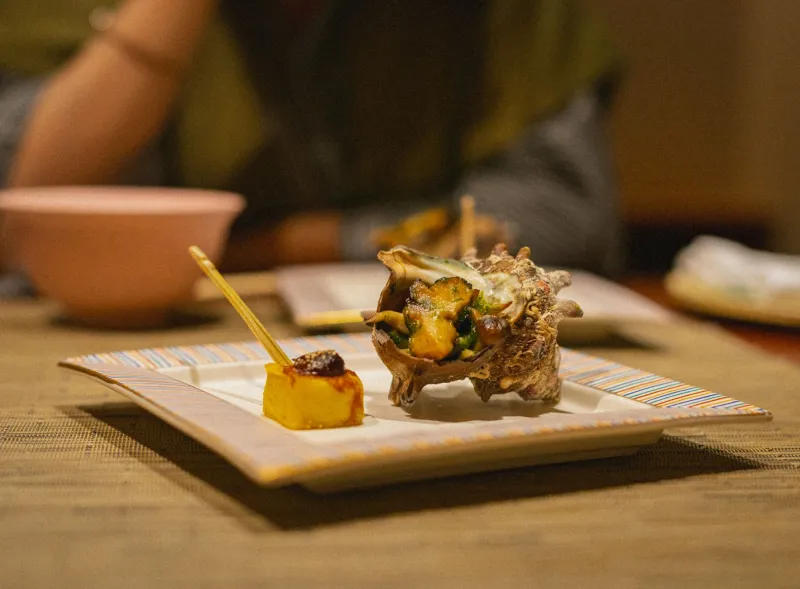
There is a moment, familiar to many first-time visitors to a traditional Japanese restaurant, when the food arrives and the eyes widen—not in delight, but in mild confusion. The plates are beautiful. The presentation is precise. And the portions are, by American standards, remarkably small.
For a country that has grown accustomed to heaping bowls and plates that extend beyond their rims, this encounter can feel disorienting. Yet what appears to be restraint is, in the Japanese dining tradition, a form of profound respect—for the ingredient, for the diner, and for the act of eating itself.
The Philosophy Behind the Portion
Japanese culinary culture is guided by a concept known as hara hachi bu, a principle rooted in Confucian teaching that translates loosely as "eat until you are eighty percent full." The idea is not deprivation. It is calibration. By stopping just short of complete fullness, the body is given room to process, the mind remains clear, and the meal itself is remembered with pleasure rather than discomfort.
This philosophy permeates the structure of a traditional Japanese meal. Rather than a single large entrée, diners are presented with multiple small courses—each one distinct in flavor, texture, and preparation. A piece of grilled fish here, a small dish of pickled vegetables there, a lacquerware bowl of miso soup, a modest portion of steamed rice. No single element overwhelms the others. Together, they compose something whole.
The result is a dining experience that engages attention at every stage. There is no opportunity to eat mindlessly when each course demands its own consideration.
Why Americans Find This Difficult
It would be unfair to frame American dining expectations as simply excessive. They are, in many ways, a product of cultural history—of abundance as aspiration, of generosity expressed through volume, of value measured in weight. A large portion has long signaled hospitality in the American context. To send someone home hungry is to have failed as a host.
But this framework creates a particular challenge when Americans sit down at a Japanese table. The question "Is this enough?" arises almost reflexively, even before the first bite. The mind has already begun calculating rather than anticipating.
What tends to happen, however, is something unexpected. By the end of a well-composed Japanese meal—even one with modest individual portions—many diners report feeling genuinely satisfied. Not stuffed. Not searching for more. Satisfied in a way that feels different, quieter, more settled.
This is not coincidence. It is design.
The Nutritional Argument, Made Elegantly
Science has offered its own endorsement of the Japanese approach. The human brain requires approximately twenty minutes to register fullness after the stomach has begun receiving food. A meal consumed quickly and in large quantities outruns this signal entirely. By the time the message arrives, the damage, so to speak, is already done.
Japanese meal structure, with its succession of small courses and its cultural expectation of unhurried dining, naturally accommodates this delay. Each course is savored. Conversation fills the intervals. The body is permitted to speak before it is overwhelmed.
Studies examining the longevity and health outcomes of populations in Okinawa—where hara hachi bu is practiced with particular consistency—have pointed to this habit as one contributing factor among several that support longer, healthier lives. The evidence is not absolute, but it is compelling.
What Quality Reveals When Quantity Steps Aside
There is another dimension to this conversation that goes beyond nutrition, and it is perhaps the more interesting one for the dedicated diner.
When a single piece of fish is placed before you—carefully sourced, precisely cut, prepared with techniques refined over generations—your relationship to that ingredient changes. You are not dividing your attention across a platter. You are meeting this one thing fully.
Japanese chefs understand this dynamic intimately. The restraint of the portion is, in part, a deliberate act of focus. It says: this is worth your complete attention. A chef who serves less is often a chef who is asking more of the diner—more presence, more awareness, more willingness to taste rather than simply consume.
For American diners who have rarely been invited into this kind of attentiveness, the experience can be quietly revelatory. The flavors are not more complex because the portion is smaller. But they become more legible. The subtlety of a dashi broth, the clean finish of properly aged soy, the faint mineral quality of fresh seafood—these are things that reveal themselves to an unhurried palate.
Reframing Value at the Table
The deeper cultural shift required of American diners is a reexamination of what constitutes value in a dining experience. If value is measured in cubic inches of food per dollar spent, Japanese dining will always appear to come up short. But if value is measured in the quality of the experience—in how one feels during the meal, in what one remembers afterward, in the care that went into every element of what was served—the equation changes entirely.
This is not an argument that every meal should be a minimalist exercise in restraint. American food culture has its own richness and its own forms of meaning. But engaging seriously with the Japanese portion philosophy offers something genuinely useful: a reminder that eating can be an act of attention rather than accumulation.
At Tamaniwa Ebisu, this philosophy informs not only what is served but how it is served—and why. Each dish is composed with the understanding that the diner deserves to be satisfied rather than simply filled, engaged rather than overwhelmed.
An Invitation to Eat Differently
The next time a plate arrives and the first instinct is to measure, consider pausing instead. Consider what is actually present on that plate—the color, the arrangement, the aroma before the first bite. Consider that someone made a deliberate choice to serve exactly this much, and no more.
Then eat slowly. Let the courses come in their own time. Notice, somewhere around the third or fourth dish, that the hunger has quieted without ever having been silenced by force. Notice that the meal is still interesting, still engaging, still offering something new.
That is the Japanese portion at work. Not a restriction. An invitation.