Sacred Objects, Visible Intentions: The Spiritual Symbolism Behind Japanese Restaurant Décor
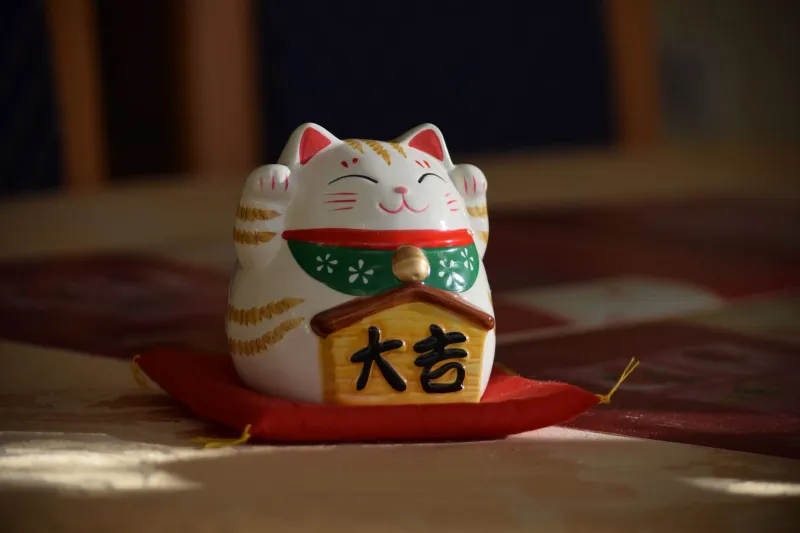
When you step into a well-appointed Japanese restaurant, you may notice a small ceramic figure near the host stand—a rotund, cheerful deity clutching a fishing rod and a sea bream. Beside it, perhaps, rests a folded paper charm or a coin worn smooth by decades of reverent touch. To the uninitiated American diner, these objects might register as quaint cultural decoration, charming but ultimately peripheral to the meal ahead. They are, in fact, anything but peripheral.
In Japan, the deliberate placement of sacred objects throughout a dining establishment is a practice rooted in centuries of Shinto belief, Buddhist tradition, and mercantile custom. Every talisman, every coin, every carved figurine occupies its position with intention. To understand what these objects are communicating is to access an invisible layer of meaning that shapes the entire dining experience—before the first dish arrives, before the first word is spoken.
Ebisu and the Language of Prosperity
The most commonly encountered figure in Japanese restaurants, both in Japan and in authentic establishments across the United States, is Ebisu—one of Japan's Seven Lucky Gods and the patron deity of fishermen, merchants, and diligent workers. Ebisu is almost always depicted in the same manner: a broad smile, a tall ceremonial hat, a fishing rod in one hand, and a large red sea bream tucked under the other arm.
His presence near the entrance of a restaurant is not accidental. Ebisu is understood to bless the establishment with good catches—both literal and figurative. For a restaurant, this translates to an abundance of fine ingredients, loyal guests, and a prosperous business conducted with honesty and care. The sea bream he carries, known in Japanese as tai, is itself a symbol of auspiciousness, its name forming the root of the word medetai, meaning joyous or celebratory.
When a restaurateur places an Ebisu figurine in plain view, they are making a public commitment: this establishment honors the source of its ingredients, values the relationship between sea and table, and invites good fortune through diligence rather than luck alone. For the American diner, recognizing this symbolism reframes the entire meal as something that has been spiritually as well as culinarily considered.
The Coin and the Threshold
Beyond Ebisu, you will often find coins—sometimes antique, sometimes contemporary—positioned near entrances, beneath flower arrangements, or within small wooden shrines called kamidana that may be mounted high on a wall. These coins carry layered significance.
In Shinto practice, coins are offerings to the divine, tokens of gratitude and petition offered at shrines across Japan. Their presence in a restaurant echoes this tradition, serving as a quiet acknowledgment that the business operates under something greater than commercial ambition. The threshold of a Japanese restaurant, in this light, becomes a liminal space—a boundary between the ordinary world outside and the carefully ordered world within.
Some establishments in the United States have thoughtfully preserved this practice, incorporating antique Japanese coins into their décor not as novelties but as genuine gestures of continuity with tradition. When a diner crosses that threshold, they are, knowingly or not, stepping into a space that has been blessed and bounded by intention.
Paper Charms and the Invisible Architecture of Care
Less visible but equally significant are the omamori—small fabric or paper charms purchased from Shinto shrines—that may be tucked discreetly into a private dining room, hung near a kitchen entrance, or placed within a decorative alcove called a tokonoma. These charms are typically obtained by the restaurant owner or head chef during New Year visits to a local shrine, renewed annually as an act of spiritual maintenance.
The omamori is not a passive object. It requires active renewal, deliberate acquisition, and respectful placement. In a restaurant context, it communicates something profound to those who understand its presence: that the people running this establishment return, year after year, to seek blessing for the work they do and for the guests they serve. It is an act of humility dressed in brocade fabric.
For American diners accustomed to restaurants that communicate their values through mission statements on menus or framed photographs on walls, the omamori offers a strikingly different mode of declaration—one that operates below the threshold of language.
The Tokonoma: A Stage for Meaning
In more formal Japanese dining rooms, particularly those designed for kaiseki or private omakase experiences, the tokonoma serves as the spiritual and aesthetic focal point of the space. This recessed alcove typically displays a hanging scroll, a seasonal flower arrangement, and occasionally a single significant object—a piece of pottery, a carved stone, or a meaningful talisman.
The objects within the tokonoma change with the seasons and the occasion, reflecting the Japanese principle that a dining space must be alive to time. A winter arrangement might feature bare branches and a scroll bearing a calligraphic reference to cold clarity. A spring setting might introduce a single plum blossom and a poem about renewal. The sacred object placed within this context becomes part of a curated dialogue between the room and the moment.
In the United States, a growing number of Japanese fine dining establishments have incorporated tokonoma into their private rooms, understanding that American diners who seek authentic experiences respond deeply to spaces that feel considered rather than merely decorated.
What These Objects Ask of You
Recognizing the spiritual objects within a Japanese restaurant changes your relationship to the space. You are not simply a consumer entering a commercial transaction. You are a guest entering a space that has been prepared for you with care that extends beyond the culinary.
This awareness invites a corresponding quality of attention—a willingness to notice, to slow down, to receive the meal as something that has been blessed as well as crafted. American dining culture tends to move quickly, to prioritize novelty and efficiency. The presence of sacred objects in a Japanese restaurant is, among other things, a gentle invitation to do otherwise.
The next time you are seated in a Japanese dining room and notice a small Ebisu figure watching over the room with his perpetual smile, consider what he is actually saying. He is not simply decorating a shelf. He is testifying to the character of the people who placed him there—their relationship to their ingredients, their guests, and the ancient, ongoing conversation between human effort and divine grace.